The audit management software for your QM
The audit management software for your QM
The audit management software for your QM
Why Choose roXtra Audit Software?
All audit types
Whether internally, with suppliers or for recertification: all in one tool
Standard-compliant auditing
Individual or standard questionnaire possible & AI support on request
Offline, remote or mobile
With and without the internet: flexible auditing anywhere - even with a tablet & smartphone
Working across systems
Linking measures, risks and processes - directly in the audit
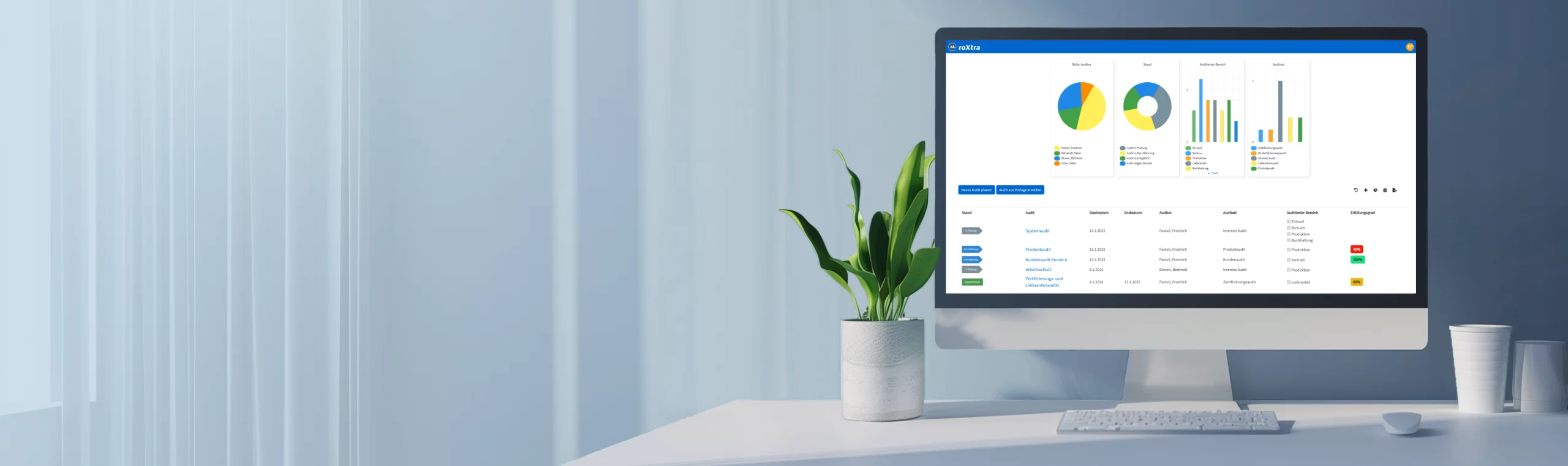
Clear dashboard
Diverse evaluation options & individually customizable graphical display
Full transparency
Clear reports & automatic effectiveness checks for sustainable success
Whether you’re a small or medium-sized business or an international corporation, audit management works the same way for companies of all sizes and is fully scalable—from a single user to multiple users. You don’t need any programming knowledge or your own IT department to set it up and use it. You can configure audit programs and questionnaires yourself.
Get advice now
Get to know roXtra in a non-binding and free online presentation.
Get advice now
Get to know roXtra in a non-binding and free online presentation.
Suitable for all audit types
Internal audit
Customer & supplier audit
Third-party audit
System audit
Process audit
Product audit
Integration into Your Existing System Landscape
An audit management system that operates in isolation creates duplicate work. That's why roXtra imports users directly from your directory service—whether it's Active Directory, Entra ID, or Okta—so that no one has to maintain master data twice.
Several interfaces are available for interacting with adjacent applications. Using webhooks and service tasks, you can trigger actions in other systems or have actions triggered from there; through database access to MS SQL and MySQL, you can access existing data. This allows audit data to be transferred to other systems or industry-specific solutions.
The connection is established via these open interfaces rather than through a pre-built connector provided by the manufacturer. This makes it possible to connect even systems for which there is no standard connection.


Choosing Audit Software: Six Criteria
When selecting the right audit software, you can use the following criteria, among others, as a guide.
| Criterion | The question behind it |
| Types of Audits | Are internal audits, supplier audits, process audits, and system audits covered b ? |
| Offline Capability | Does the system work without a stable internet connection—for example, —in a production environment? |
| Link to the Measure | Does a deviation automatically trigger a corrective action, including an assessment of its effectiveness ( )? |
| Standard Compliance | Are the standards under which you are certified listed? |
| Reporting | Can the audit report be generated without any additional work and shared at ? |
| Data base | Does audit management have access to the same documents, processes , and risks as everyone else? |
Further information on the audit management software from roXtra
Audit management made easy with roXtra
What is audit management?
Audit management refers to the systematic planning, execution, and follow-up of audits—that is, the entire cycle, not just the day of the audit.
First, it is determined which areas will be audited, when, and according to what criteria. This is followed by the preparation, conduct, and evaluation of the audit. What happens on-site after the audit is crucial: Identified nonconformities must be translated into specific actions, responsibilities must be assigned, and the effectiveness of these actions must be verified. Only then does an audit contribute to the long-term improvement of processes and management systems.
How does audit management software work?
Audit management software helps you plan, conduct, and evaluate audits. It centrally manages checklists, audit reports, and corrective actions in one place and ensures that deadlines, tasks, and supporting documentation are always visible. It helps you identify and resolve internal nonconformities early on to ensure continuous improvement.
A distinction is made between internal and external audits. Internal audits, also known as 1st party audits, are carried out by employees of the company itself in the form of a self-audit. 2nd party audits and 3rd party audits are carried out externally.
Product audits, which ensure compliance with the requirements of individual products, play a particularly important role in quality management. However, system audits to check the functionality of the entire management system and process audits to check the performance of processes are also among the various types of audit.
Audit management software such as roXtra Audits enables the structured management of different audit types:
- Internal audits (1st party audits): Self-audit by own employees
- 2nd party audits: Supplier or customer audits
- 3rd party audits: Certification audits by independent organizations
- Product audits: Ensuring product requirements are met
- System audits: Review of the entire management system
- Process audits: Evaluation of the performance of individual processes
What are the benefits of digital audit management software?
Digital audit management software saves time, provides transparency, and reduces sources of error. Audits can be planned, documented, and evaluated centrally. All stakeholders work with up-to-date information, results are traceable at any time, and corrective actions can be consistently tracked.
How does roXtra assist with the planning and execution of audits?
roXtra supports the entire audit process—from planning and execution to follow-up. Audits are planned in a structured manner, tasks are clearly assigned, and checklists are provided digitally. Auditors can record results directly, ensuring a seamless workflow.
How long should the preparation for the audit take?
That depends on the type and scope of the audit. The sooner you start, the smoother the process will go. In many cases, it makes sense to begin preparations a few weeks in advance. This allows enough time to review relevant documents, involve the necessary parties, and resolve any outstanding issues before the audit.
What types of audits can be mapped?
roXtra allows you to flexibly conduct various types of audits, such as internal audits, supplier audits, process audits, or certification audits. The solution can be used across all industries and can be customized to meet specific requirements.
What is an internal audit?
An internal audit is an examination of processes, procedures, or management systems within a company. It helps identify weaknesses, ensure compliance with legal requirements, and recognize opportunities for improvement at an early stage.
What are the most important criteria for an audit?
The key focus of an audit is whether requirements are being met and processes are functioning effectively. The criteria for this are typically standards such as ISO standards, legal and regulatory requirements, internal policies, and defined objectives. A good audit not only identifies nonconformities but also highlights opportunities for improvement.
What audit methods are there?
Auditors use a variety of methods to gain a complete picture. These include document reviews, interviews, on-site visits, and spot checks. Often, several methods are combined to validate the results.
How can I address discrepancies in the audit report?
Deviations are not a problem as long as you take the appropriate action in response. Analyze the causes, assign responsibilities, and follow up on implementation by setting agreed-upon deadlines. This way, audit findings lead to concrete improvements.
How are audit findings tracked?
Actions are created directly from audit findings, assigned to the responsible individuals, and given deadlines. Progress can be viewed transparently at any time, and reminders help ensure timely implementation and prevent anything from falling through the cracks.
In addition, business processes can be optimized for the long term, and all supporting documents can be centrally managed, controlled, and archived in an audit-proof manner.
What sets the roXtra Audit software apart from other solutions?
roXtra combines audit planning, execution, and action tracking in a single, integrated system. Audit results are documented directly and automatically translated into specific actions, including responsibilities and deadlines. Thanks to the close integration with other QM processes (e.g., document or action management), all information remains consistent and centrally available. This reduces coordination efforts, prevents data silos, and ensures complete traceability.
Do you already know our other solutions?

roXtra Documents
Manage documents according to standards and in individual workflows.